
36,900
CLICKS
7,78,000
IMPRESSION
731
CONVERSION
₹2,31,000
TOTAL AD SPEND
4.74%
CLICK THROUGH RATE
₹6.26
COST PER CLICK
1.98%
CONVERSION RATE
Campaign Overview
Platform: Google, Campaign Type: Search, Performance Max, Call Ads. Campaign Period: 1 Month. Industry: Training & Placement Institute. Target Area: Nagpur and surrounding city.
The Challenge
The client came to Nagpur Soft Tech with a clear business problem: they were investing in Google Ads but not seeing consistent, cost-efficient lead generation. The account had volume — but not the right kind.
Key problems before the campaign restructure:
- High cost per lead from unoptimised broad match keywords consuming budget on irrelevant searches
- No conversion tracking in place — decisions were based on clicks alone, not actual enquiries or sales
- Ad copy not aligned to intent — generic headlines failing to qualify the right visitors
- No negative keyword list, allowing budget bleed on competitor brand terms and informational queries
- Campaign structure mixing multiple product/service lines into one ad group, diluting relevance scores
The goal: restructure the account to generate a high volume of qualified leads while keeping cost per conversion at a level that made business sense for the client.
Our Approach
Nagpur Soft Tech rebuilt the campaign architecture from the ground up — focusing on three core levers: account structure, keyword intent, and conversion-optimised bidding.
- Account Restructure — One Theme Per Ad Group
- Separated campaigns by product/service line so each ad group had tight keyword-to-ad alignment
- Single Keyword Ad Groups (SKAGs) approach for highest-priority terms to maximise Quality Score
- Separate campaigns for branded, competitor, and category terms to allow independent budget control
- Keyword Strategy — Intent Over Volume
- Shifted to phrase match and exact match from broad match to protect budget from irrelevant traffic
- Built a comprehensive negative keyword list covering generic, informational, and competitor terms
- Added city-level and locality-level modifiers to attract Nagpur-specific high-intent searchers
- Conversion Tracking and Smart Bidding
- Set up full conversion tracking for form fills, call clicks, and WhatsApp button interactions
- Started on Manual CPC to gather data, then migrated to Target CPA once 30+ conversions were recorded
- Weekly performance reviews: paused low-CTR ads, scaled budget toward top-performing ad groups
- Ad Copy Testing
- Ran Responsive Search Ads with 8–10 headline and 4 description variants per ad group
- Used pinned headlines for brand and USP, letting Google optimise supporting copy
- A/B tested benefit-first vs. offer-first messaging to identify what resonated most with the target audience
Campaign Results — February 2026
The following metrics are pulled directly from the Google Ads dashboard for the full month of February 2026.
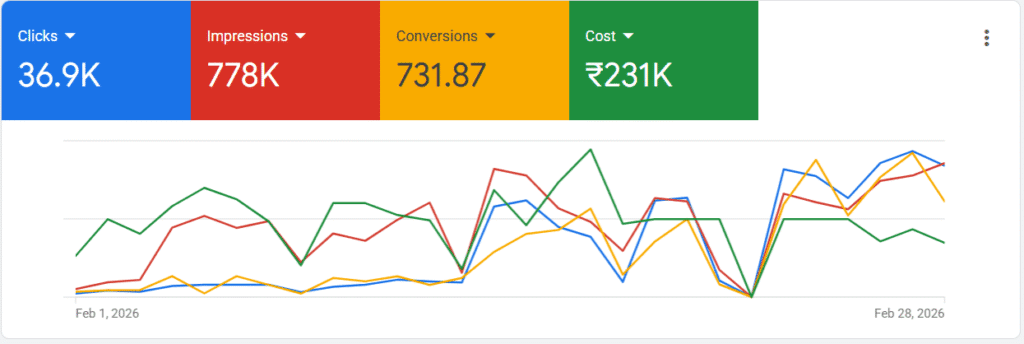
CPC of ₹6.26 vs. industry average of ₹10–₹25. CPL of ₹315.64 vs. industry average of ₹600–₹1,500. The campaign achieved above-average efficiency on every cost metric.
Campaign Trend: Stronger in the Second Half
The Google Ads performance graph shows a clear pattern across the 28-day period. The first two weeks showed moderate and fluctuated-February onwards, all four key metrics — clicks, impressions, conversions, and spending performance as the smart bidding algorithm collected conversion data. From mid, efficiency moved upward together. This is the expected trajectory of a well-structured campaign. Smart bidding requires a learning period. The campaign ended February at its highest weekly performance point, meaning the momentum carried into March from a stronger baseline.
Best practice: Do not pause or significantly alter a Google Ads campaign during the first 4 weeks. Disrupting the learning period resets the algorithm and wastes the data already collected.
Key Takeaways
4.74% CTR — ads that earn clicks instead of just appearing
CTR is a direct signal of ad relevance. At 4.74%, the ads were connecting with what people were actually searching for. This is the result of tight keyword-to-ad alignment — not generic copy blasted across all searches.
₹6.26 CPC — quality score doing the work, not just budget
Google rewards relevance with lower CPCs. At ₹6.26, the campaign was paying less per click than competitors bidding on the same terms with lower Quality Scores. Account structure determines CPC as much as bid amounts do.
₹315.64 cost per lead — well inside viable acquisition cost
At ₹315.64 per conversion, the campaign achieved less than half the industry average cost per lead. For any business where a customer is worth more than that over their lifetime, this channel is profitable from day one.
731 conversions — volume and efficiency together
Getting a low CPL is easy if you run a tiny campaign. Getting 731 conversions in one month while maintaining a CPL of ₹315 is the harder achievement. This is what a properly scaled, properly structured Google Ads account looks like.